

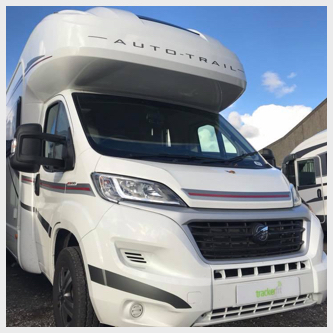
For many owners, a motorhome represents a significant financial commitment built up over years of saving and planning. It supports holidays, extended travel, and time away, while often being one of the most valuable assets they own outside their property. Unlike cars, motorhomes are commonly stored away from home, left unused for long periods, and parked in locations with limited day-to-day oversight. These conditions increase exposure to organised vehicle theft.
At Trackerfit, we speak to motorhome owners who believe their vehicle is protected because it is locked, alarmed, or stored in what appears to be a secure compound. Theft cases often show a different reality. Vehicles can be taken quickly and quietly, with alarms bypassed and locks defeated before anyone nearby notices. Once a motorhome leaves its storage location, physical security measures no longer provide any information about where it has gone. This is the gap that tracking technology is designed to address.
Why motorhomes attract organised theft
Motorhomes combine high resale value with ease of movement, which makes them attractive to organised theft groups. Once access is gained, standard immobilisers and alarms can often be bypassed within minutes using relay equipment or cloned keys. Because many motorhomes are stored off-site, thefts may not be discovered until hours or days later.
After a theft, vehicles are rarely driven straight to a final destination. They are often moved between temporary locations, concealed in industrial units, or transported across regions to avoid detection. This rapid movement makes recovery difficult. Without location data, owners and insurers rely on chance discovery rather than informed action.
Physical deterrents such as steering locks and alarms still have value, but they only offer protection while the vehicle remains stationary. Once it is moved, those measures provide no information about location or direction of travel. This is where a tracker becomes a core recovery tool rather than an added extra.
How a motorhome tracker improves recovery chances
A motorhome tracker uses GPS technology alongside GSM and GPRS communication to report the vehicle’s location. GPS determines position, while GSM and GPRS transmit that data over mobile networks so the location can be viewed in near real time.
If unauthorised movement occurs, alerts can be triggered immediately, either directly to the owner or through a monitoring centre, depending on the system in place. The timing of detection and response after a theft has a direct impact on recovery outcomes. Vehicles are most likely to be recovered when movement is identified early, before they are concealed, transported further, or dismantled.
A tracker reduces the delay between the moment a theft occurs and the point at which action can be taken. Location data becomes available as soon as the vehicle starts moving, rather than relying on the owner discovering the theft later. This allows recovery teams or authorities to act while the motorhome is still in transit, which significantly improves the likelihood of locating it intact.
Many modern trackers also include motion sensing, tamper alerts, and geofence settings. These features help identify unusual activity such as movement during restricted hours or interference with the device itself. Owners gain continuous oversight of their vehicle without relying on periodic checks.
Understanding alternative tracking technology
Some tracking systems use different methods to locate vehicles. For example, the brand Tracker uses VHF, or very high frequency, technology. VHF works by transmitting radio signals rather than relying on satellite positioning.
One key advantage of VHF is that the signal cannot be blocked in the same way as GPS. It also uses a unique MESH system, which allows signals to bounce between other vehicles fitted with the same technology. This increases detection capability even when a stolen vehicle is concealed.
In addition, UK police vehicles and helicopters are equipped with VHF detection equipment, which allows them to actively locate vehicles fitted with this type of system during recovery operations. This approach differs from GPS-based systems and may suit owners who want police-led tracking support.
Ongoing protection during storage and inactivity
Motorhomes are often unused for extended periods, particularly during winter or when owners travel abroad. During these times, visiting the vehicle regularly may not be practical, which makes tracker performance during inactivity essential.
Trackerfit supplies systems designed for long battery life and low power consumption. This allows tracking to continue even when a motorhome is parked for weeks or months. Owners can confirm the vehicle’s location remotely and receive alerts if movement occurs unexpectedly.
This level of oversight is especially useful for vehicles stored in compounds, farms, or shared facilities where access is limited and regular checks are unrealistic.
Why professional installation makes a difference
Installation quality has a direct impact on tracker performance. Poorly fitted units can suffer signal loss, battery drain, or be located quickly by thieves. Discreet placement reduces the risk of tampering and supports long-term reliability.
Trackerfit provides nationwide installation carried out by trained engineers who are fully insured and TASSA approved. Fitting can take place at home, at a storage site, or at a dealership, depending on owner preference. Each installation is tested to confirm correct operation before completion.
For many owners, installation can be arranged quickly, which allows protection to be put in place without long delays.
Choosing a tracker that fits how you use your motorhome
Motorhome usage varies widely. Some owners travel year-round, others store their vehicle for long periods, and some regularly take motorhomes overseas. These patterns influence which tracker features are most relevant.
Trackerfit offers a range of systems to suit different requirements. Options include monitored subscription trackers, discreet self-monitored units, and subscription-free systems for owners who prefer a single upfront cost. Advice is provided based on storage location, frequency of use, and the level of response required if a theft occurs.
This approach helps owners choose protection that reflects how their motorhome is actually used, rather than paying for features that offer little practical benefit.
Protecting your investment with confidence
Motorhome ownership should remain focused on travel and enjoyment, rather than concern about theft. A tracker provides practical protection through visibility, early warning, and a clearer recovery route if a vehicle is taken.
If you are considering securing your motorhome, you can browse the Trackerfit range online or speak directly with the team on 0800 756 5100 for advice based on your vehicle and usage.